
Home › Forums › Club Races › Racing Calendar, Classes & Regulations › 2021-Tourist Trophy Series (H2-2021)
Tagged: 2021 Series - Tourist Trophy
- This topic has 34 replies, 6 voices, and was last updated 4 years, 8 months ago by
 BarkingSpyder.
-
AuthorPosts
-
June 7, 2021 at 6:37 PM #16591
Erik
CSX 2299 is not a 427. 427s start with chassis number CSX 3XXX. Your car was the second Daytona Coupe completed. I have the Monogram Viking Blue #21 CSX 2299. While we encourage period liveries and allow fantasy liveries, there is no need to repaint your car. Besides, I think the 65 Guardsman Blue car looks better. My #21 has a 3D printed chassis and a thin, sheet aluminum interior, with thin-cast resin dash, console, driver, and spare tire/wheel. I have flat sheet plastic interiors in other TT cars, with dash top and driver head and shoulders that look fine and are easy to do. I would think that the front motor would be very difficult to make competitive.
CSX 2299, after an impressive list of drivers in period, was sold to Michael Shoen in 1969 for $5100. Mike Shoen wrote The Cobra-Ferrari Wars.
Looking forward to seeing your car. I plan on being at HQ on Saturday and bring my six TT cars to test.
Russell
June 9, 2021 at 8:51 AM #16592[attachment file=”IMG_1112.jpg”]
I got the Fly 250LM sidewinder running. It has the Slot Car Corner front axle blocks installed which required removing front chassis plastic and installing the grill surround without the screws. It was similar to the description in Ary’s McLaren how-to on our site. It is also running a slot.it orange bell with metal gears. That spacing of the gears was a challenge and almost pushed me to use the Fly short can black bell motor with the plastic gears. The rear axle is rolling in SCC bronze bearings. The guide is a slot.it long wood track model. The Fly model has beautiful interior detail which is what lead me to use the fly chassis sidewinder setup. The 3D printed chassis requires inline motor orientation that causes fabrication of a new flat interior. I did not want to do that if I could soup up the Fly sidewinder chassis. As a result of keeping the full interior I also have put in flat lead sheet and the tungsten weight in the magnet slot. The final touch is using the Racer premium wire wheels from my previous 275GTO and the tires. I ran best lap with the body of 4.6 =/-. The chassis alone was 4.4 and very stable.
June 10, 2021 at 10:59 AM #16611Like Randy I am running for Fun, using my 2017 vintage FLY Ferrari ’63 250-GTO
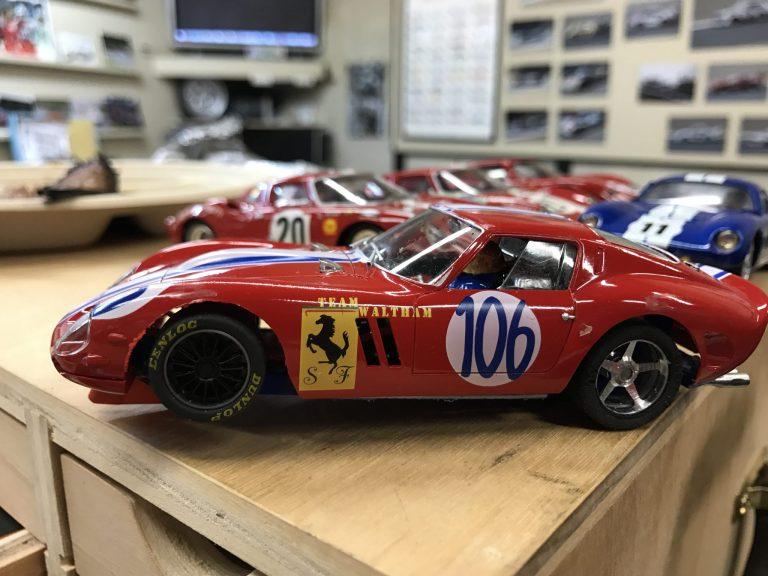
"... get on your bad motor scooter and ride!"
Sammy with MontroseJuly 27, 2021 at 1:44 AM #16769Team 8 Ball Cobra roadster hardtop will show up for race two. Scrapped the attempt begun three begun years ago to alter the MRRC front axle setup for a new 3D chassis.
Attachments:
August 9, 2021 at 10:39 AM #16810“Missed it by … “That Much” … ” (maxwell smart)
Of course, after a good first round my tires decided to break their glue, with symptoms such as jack-rabbit hops in the back straight (when the wheels would spin inside the tire, then finally grab the bead and hence flip the car).
After several frustrating experiments with freshly glued and trued tires; it became obvious that for my set-up a trued 19mm outside diameter tire is optimal. Any tires larger than 19.5mm in diameter make the car want to roll like an armadillo in the “button” curve, esp. in Green.A low Center-of-Gravity (CG) is very important in All cars – but especially for these skinny-track cars. Even though the Fly bodies seem to be made of the same plastic as other brands, and seem to be as thin (certainly thinner than Scalextric and most Pioneer/Revell) it seems they are a few grams top-heavy, thus making cornering very challenging (esp. using OEM stock chassis). Another contributor is the shape of most of the coupe bodies, with mass peaking a little back of the center of the wheelbase (encouraging rolls and slides from the JLO shape).
Offset motor pods help, as well as small diameter tires, Lexan cockpits, and 3DP chassis.
"... get on your bad motor scooter and ride!"
Sammy with Montrose -
AuthorPosts


- You must be logged in to reply to this topic.