This is the head thread of the series discussion for 2021 – NSR Formula 86/89
2021–NSR Formula 86/89
12

This is the head thread of the series discussion for 2021 – NSR Formula 86/89
At this time I would say it is up to the series manager to decide whether or not the Slot It crown gears are allowed. Please post any concerns here so David can review them.
John
The issue with the stock crowns is the wearing of the channel for the motor shaft, right? (too tight? too binding?) Or is there some issue with the mesh itself? If it is the wearing/friction, then cutting off the end of the motor shaft and adjusting everything tightly, without too much side axle play, would seem the simplest solution. Assuming that would be legal..... I have not had a chance to run my car at all, but that is probably the first thing I would try.
.
from John: 1st - reference: Post-16688
1 The shallow depth of the NSR crown teeth, presses the motor shaft disproportionately against the Thin (0.50mm) "guard-flange" of the Centering Channel.
2 With the Aluminum shank crowns, the guard-flange wears quickly, shedding AL dust and distorting the shape of the Centering Channel.
3 After less than an hour (on a rolling-road) the crown's mesh has changed (the teeth are alternatively pressing harder/loser against the pinion). Friction increases noticeably.
4 The NSR brand Brass/Bronze shank crowns take over 45 minutes before they start shedding from wear on the guard-rails. The NSR Brass/Bronze crowns also have a (0.50mm) guard-flange.
5 The Slot.IT brand Brass/Bronze shank crowns have a (0.75mm) guard-flange. After 30 minutes on the rolling-road, the Slot.IT Brass/Bronze crowns seem to have little shed, and NOT degrade in mesh/lash (and hence performance.) The slight eccentricity from the Slot.IT having a larger diameter hole 2.38mm (2.998/32 inch, 0.09370in) vs. 2.37mm (2.9858/32 inch, 0.09331in) for the NSR axle, does Not seem to have any obvious consequences.
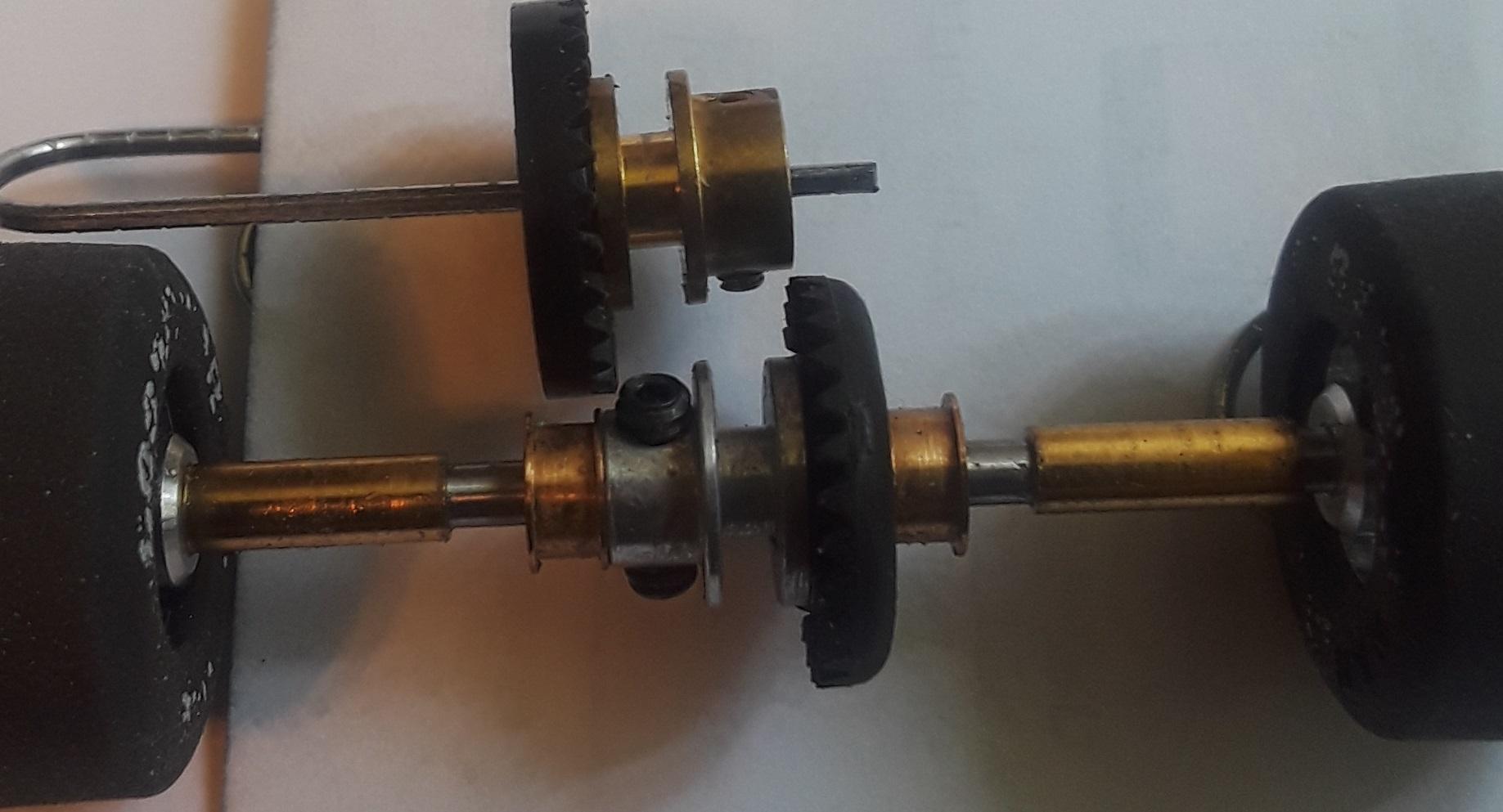
6 Russ' solution to use the OEM brass spacers, and Trim the shaft so that it no longer contacts the Centering Channel - seems to be an easy and viable solution.
from Mark:
The wear issue appears to be either a flaw in the Design of the Crown's teeth (too shallow) or in the Manufacturing during alignment on the Shank (computer parameters mouning the crown on the shank too close to the centering-channel). The skinny 0.50mm Guard-Band also seems like a Doofus design choice with no apparent cost/weight/performance benefit. Note that most NSRs are either short-can pseudo-sidewinders (2deg AW) or long-can angle-winders; so their overall experience with Inlines seems limited (e.g. only ocurrent models with ILs are Mosler, Clio, Abarth, LMP, F1)
In conclusion - I join John in (a) requesting that both (a) the Slot.IT crowns (b) and trimming the motor shaft be Permitted.
I agree that stop collars can produce more drag, but they are not the only option. Attached is a photo of my Jaguar lightweight that I built four years ago. I am doing some work on it. I originally had two stop collars on it. I put a .005 Slot Car Corner axle spacer, then a .100 axle spacer on the outside of the motor pod, opposite the crown teeth. This limits the axle side play away from a tight gear mesh. The original axle collar is still located behind the crown gear, but it no longer makes contact; the .100 spacer is the limiter. I will probably be removing the collar. Although not totally necessary, I will probably put a spacer on the other end of the axle that will limit the axle play toward tight gear mesh. That way, instead of side load to the crown gear, the side loads will be to the two axle spacers. Once adjusted there will be no more drag than axle spacers. I will see how it works when I have a chance to test it.

Russell
Nice work Russell. I agree with your assessment of axle collars. I'm going to try running without them to see how it goes.
Marty
VIDEO OF USING STOP COLLARS AND TRUNCATED MOTOR SHAFT
"This is basically what Russ described, a nice how-to video from NorCal " Marc/Datto
RUSS - where did you get the 3DP motor pod with adjustable off-set? Is it easy to adjust?
Are we allowed to put nail polish or other compound on the front wheels to lessen the grip?
Marty
I would like a ruling from the Series Manager. There are now several tire/wheel options from NSR for the F1-86/89.
REAR TIRES:
OEM/original (19.5 X 13) NSR-5284 (Supergrip 25shore?) 5284 (Ultragrip 15~20shore?)
Alternative (19.0 X 13) NSR-5287 (Supergrip) 5288 (Ultragrip)
Both 19.5 and 19 OD fit the NSR F1 wheels with a 13mm Diameter Rim/bead.
FRONT TIRES: NSR-5290 (16X8) NSR-5291 (17X10) Zerogrip (fit the same wheel-5020)
WHEELS
REAR OEM NSR-5021 have an "air-system" Rib/Nib. 13mm OD x 10mm width
NSR-5027 - Solid Rib/Nib. 13mm OD x 10mm width
NSR-5022 -"air-system" 13mm OD x 13mm width
NSR-5026 -"air-system" Drilled - 13mm OD x 13mm width
FRONT OEM NSR-5020 solid Rib/Nib. 13mm OD x 8mm width
I would suggest keeping the rules for the cars as stock as possible. I don't see a need to upgrade or change wheels or tires as the stock ones work well. This will also help keep costs down.
Having said that, the crown gear could be another conversation.
GEAR RATIO CHOICES WITH THE AVAILABLE CROWNS: 27z 25z 24z
The calculated rear-wheel-RPM - OEM @12volts: OEM ratio 21,400/(27/10)
= 21,400/2.7 > 7,926 **
Other Gear Options: @12volts
24/9 = 2.67 > 8,015 **
25/9 = 2.78 > 7,698
// not really usable at 12v
...27/9 = 3.00 > 7,134; ...25/10 = 2.50 > 8,560; ...24/10 = 2.40 > 8,917
@11volts OEM ratio 27/10 = 21,400(11/12)/2.7 = 19,617/2.7 > 7,265
24/10 = 2.40 = 8,174 **
25/10 = 2.50 = 7,847 **
...24/9 = 2.67 > 7,347; ...25/9 = 2.78 > 7,056; ...27/9 = 3.00 > 6,539
SPARES
OEM NSR 6327AL 27 tooth black crown, Aluminum shank
NSR 6324BR - bronze/brass shank
NSR 6325BR
NSR 6327BR
OEM NSR 7010-10 tooth "easy" pinion. 5.5mm OD
NSR 7009-9 9 tooth
NSR 6809-9 Lightweight
NSR 6809-10 Lightweight
Gear Pitch
Ary wrote a terrific article on gear pitch 10 years ago that everyone should read: http://austinslotcarclub.com/forums/topic/gears-pitch-mesh-a-look-into-slot-it-variable-pitch-gears/
With the diameter of Slot.it pinions fixed, the pitch varies with the number of teeth, while all Slot.it crown gears have a fixed pitch of 48; their diameter changes. For that reason, the optimum Slot.it gear mesh is achieved with an 8 tooth Slot.it pinion. 9 tooth is OK too; 10 tooth is marginal, and 11 tooth should be avoided. I do not know the pitch of NSR pinions and crowns to know how they compare to the Slot.it gears. The pitch of the NSR gears can be calculated by using the formulas in Ary's article.
This is a separate issue than allowing Slot.it gears in the NSR cars, but if anyone does so, the pitch should be calculated to see how well disparate gears will mesh.
Russell
The Pitch of the NSR Pinions, Crowns and Spurs are in the '48' range.
http://austinslotcarclub.com/nsr-gears-pitch-table-1/
This is quite common in 1-32 scale gears. The tooth shape of the smaller Pinions is like a tulip or a vaulted-arch. As the tooth count increases, the shape morphs to an "I". On the drive (Crowns, Spurs, Contrate) the tooth shape is mainly a straight sided Triangle. On Offset Crowns the teeth become slanted so they can mesh easier with the pinions non-angled teeth (similar to a 1x1 differential gear).
USELESS TRIVIA
Whereas in the current 1-24 world, "Coarse" gears are 48p, and "Fine" are 72p.
yet - the most popular in current 1-24 land is 64p (medium) since it has a finer-Lash than 48p but does not Shed as fast as 72p.
If the pitch gets "too fine" (e.g. thin "A" shaped spikey teeth with "V" valleys) they can strip very easily by gunning the motor or during a crash that impacts the tire/wheel assembly (e.g. the motor grinds the pinion into the plastic when the wheel stops after hitting another car or the Wall).
Hence - in the 2021 NSR Catalog (pg27) you see a 8z(teeth) steel pinion (#7408) with a longer "hub" and 64-pitch rating. That pinion is designed to be soldered onto a 2mm motor shaft and meshed to a 64p Spur (flat or 5%-beveled); mounted in an Angle-winder orientation (pinion on left side; clockwise/righty rotation).
I was a little slow to process the data. Since the Slot.it and NSR pinions have the same diameter, each pinion will have the same pitch as their counterpart in the other manufacturer. Eight and nine tooth pinions will have the best gear pitch; ten and eleven tooth pinions should be avoided.
Russell
I had forgotten about Ary's followup on NSR gears. It just goes to show how much information is in ASCC files.
Russel
Russ - I had to double-check myself to make sure there were tables for both Slot.IT and NSR. And - to your point we have some Great assets; I always stumble across a reference to one of Ary's How-To videos or one of our Forum posts when searching the interweb for slot-car 411 :)
David posted on the home page - I spent a lot of time Saturday running my F1 with new NSR gears had no problem it ran very smooth. NSR gears is what we will use for this race.
AS OF THE CLUB MEETING 9/25 - the members present voted Aye/for and David approved the use of the Slot.IT inline crown gears.
MANDATORY: Slot.IT crowns can only match the tooth-count(z-number) offered by NSR;
24, 25, 27
RPMs: using the stock 10z pinion: at 11v: 27/10= 7265 25/10 = 7847 24/10 = 8174
RECOMENDED: Brass/bronze vs. Alloy/aluminum // brass seems to wear less.
Important Note: NSR motors are setup to turn Counter-Clockwise (lefty) vs. Slot.ITs which turn CW/righty - looking at the motor from the pinion end. If you install a crown with the plastic gear bed on the right (looking at the pinion end) the car will run Backwards, and you'll notice a slightly smaller/tighter open area in the gear box. DO NOT 'fix' the problem by swapping motor wires - you are now messing up the Advance (deg.) the motor has built into the Armature. You are also now running the armature backwards (from any break-in from the factory or when you prepp'ed it).
Some 4-40 grub screws are a little too long in the arbor/collar of the gear and can hit the motor or pinion.
/** To Series Manager Dave Cass and ASCC members; my sincere thanks for accepting the proposal to run Slot.it crown gears as an option to the NSR gears for the F1 series. These gears will make the F1 car smoother and more reliable. Ran over 200 laps today with no issues. Tip: Have added significant weight. These cars in the right hands are sub 3.8 possible. John/Lotus-JR **/
GREEN CHASSIS WEIRDNESS
Using a green ultra-hard chassis, the holes for the top Axle-grubs were tight and useful - for M2 allen grubs.
BUT the Bottom holes were so loose, I had to carefully drill a hole large enough for a 4-40 (the typical NSR grub screw) and installed the brass upgrades. CAUTION there is barely enough 'meat' in this area to allow the 4-40s. This was only My experience and fix; "your mileage may vary"; "caution - coffee is hot and should not be placed between your thighs"; "don't take stellara if you are allergic to stellara".
ESSE TURN CLIMB - the climb-out likes to porpoise the car out of the slot when entering the back 'straight'. A 1/2-mm to 1-mm flying gap with a slight bit of axle slop seems to prevent the Pop-out. 3/4 to 7/8 mm was the range my particular car seemed to "like".
I also added a 3 gm lead disk behind the guide.
Front Axle Grub Screws
I had the issue with the lower front axle grub screws not holding in the chassis; the grub screws would just spin. I took several strands of copper guide braid (maybe 6 or 7 strands), twisted it together and put it in the grub screw hole, with the end of it sticking out, and screwed in the grub screw. This seemed to make it hold. It stayed firm through the race last week.
Russell
Russell and All - The NSR replacement chassis' I received run two different grub screw sizes. The lower grub screw is the standard NSR sized grub screw while the upper one is a Slot.it sized grub screw. When installing the lower NSR grub screw it feels like it's too big and will break the chassis but they do fit. The chassis will budge out a little but that is the correct grub screw to use. There are no issues with the upper grub screws.
I don't know if this is consistent with all the chassis but it is for the three replacement chassis I received. Of the three chassis I purchased - one green and two white - the green one did not come with grub screws but both white ones did. The screws that came with the chassis were two different sizes.
So is the "standard NSR sized grub screw" the NSR 1238 M2.5 grub screw or the NSR 4809 M3 grub screw?
Russell
Officially, NSR intended these to be M2 (i.e. 2mm diameter) holes, hence the useless 2mmL x 2mmD (b/c they are Too Short) pack of M2s that should be included in your jewel case.
IMHO - this decision makes no sense from NSR (e.g. does not really make the chassis "uglier", or lose performance, to make the uprights fat enough for their typical 4-40 screws).
My first black/medium chassis accepted the M2s and I have SCC 4mm Oval-heads on the Top and Bottom.
PER MY PREVIOUS POST #16963, on my Green/X-Hard chassis the top axle adjustment screw holes *were* tight enough for M2s, yet the Bottoms were loose, forcing me to use 4-40 brass grubs (very carefully).
NOTES My new LEB Hobbies car, has wide bottom holes (needs m2.5 or 4-40). Yet - I have another spare black chassis that Is Tight Enough for the M2s (WTH?)
For the bottom - if you have M2.5 grubs (from Thunderslot?) they *may* be the perfect solution.
Otherwise you may want to TRY USING 4-40s (i.e. normal NSR, i.e. use a 0.50 wrench).
The English bit size is: 7/64 (i.e. 0.1094) which is just small enough that the 4-40 (i.e. 0.1120) can Bite into the plastic and hold.
Using the 4-40, you will see the stretch-marks, but unless you are ham-fisted the risk of damaging the chassis is Moderate. Take it slow and careful, one side at a time.
New NSR F1 rule
A new rule has been added to the NSR F1 Race Rules Page. Maximum overall axle/tire width is 68mm. This will be the limit for both rear and front axle/tires. I hesitate calling it a track width because, usually, track width (at least on 1:1 cars) is defined as the width, wheel center to wheel center. For our purposes we measure the overall width, which will be sidewall to sidewall. There was no max width specified in the original rules.
With cars with enclosed bodies, the maximum width is limited to the width of the body (and adjustments made if a car's body is out of scale). With open wheel cars, we should probably always have a max width specified.
This new rule will be implemented with NSR F1 race #3; the results of the first two races will stand, as they were raced with the rules at the time.
Getting the rear track (tire wall to wall) out to 68mm yesterday was quite a trial finding the right combo of spacers. I am hoping it was worth it. I did also change the front tire/wheel combo to the optional setup. This car could have been an excellent class strictly out of the box, as shipped, and save your time and energy instead of all of the mods we are making. rant completed.
Randy - I agree with you. It would have been good to just keep this as stock as possible. There is always next time.
Marty
WOW! That is a whole other level. I like what you are working on. I think you and Russell are the masters at that type of work. I am always impressed with the quality of work you both create. Impressive.
We only use cookies to keep you signed in and to deliver a functional experience. By continuing to browse, you agree to our use of essential cookies. Privacy policy
This video cannot play here.
Download it insteadNotifications